The 2026 Guide to Content Operations: Solving Bottlenecks and Future-Proofing Your CMSNew Blog Post
The Content Management Crisis of 2026: Is Your Infrastructure Killing Your SEO?
Let’s be honest: the "standard" way of managing content is officially broken. In a world where 85% of brand discovery now happens through AI agents and LLMs like GPT-5 and Perplexity, simply "having a blog" isn't enough. If your site takes more than two seconds to load, or if your backend is a tangled web of legacy plugins, you aren't just losing readers—you're being invisible to the AI crawlers that now dictate your search rankings.
The bottleneck isn't your ideas; it's your execution. You’re likely spending 70% of your time fighting with fragmented workflows and slow server response times ($TTFB$) instead of actually scaling your brand. This "infrastructure lag" is the silent killer of 2026. While you wait for a dashboard to load, your competitors are using agentic AI to automate their distribution and claim the top-of-page citations.
The good news? You don't need a million-dollar enterprise stack to fix it. You need a streamlined, high-performance foundation that’s built for the speed of modern search. To solve these bottlenecks, I’ve found that the single most effective move is switching to a host that prioritizes AI-driven performance.
Pro Tip: If you want to skip the technical headache and jump straight to an AI-optimized setup, I recommend starting with Hostinger’s AI-Powered Hosting. It’s the same foundation I use to ensure my content stays "discoverable" by both humans and AI agents with 99.9% uptime.
In this guide, we’re going to break down the five biggest content bottlenecks of 2026 and—more importantly—give you the exact blueprints to solve them.
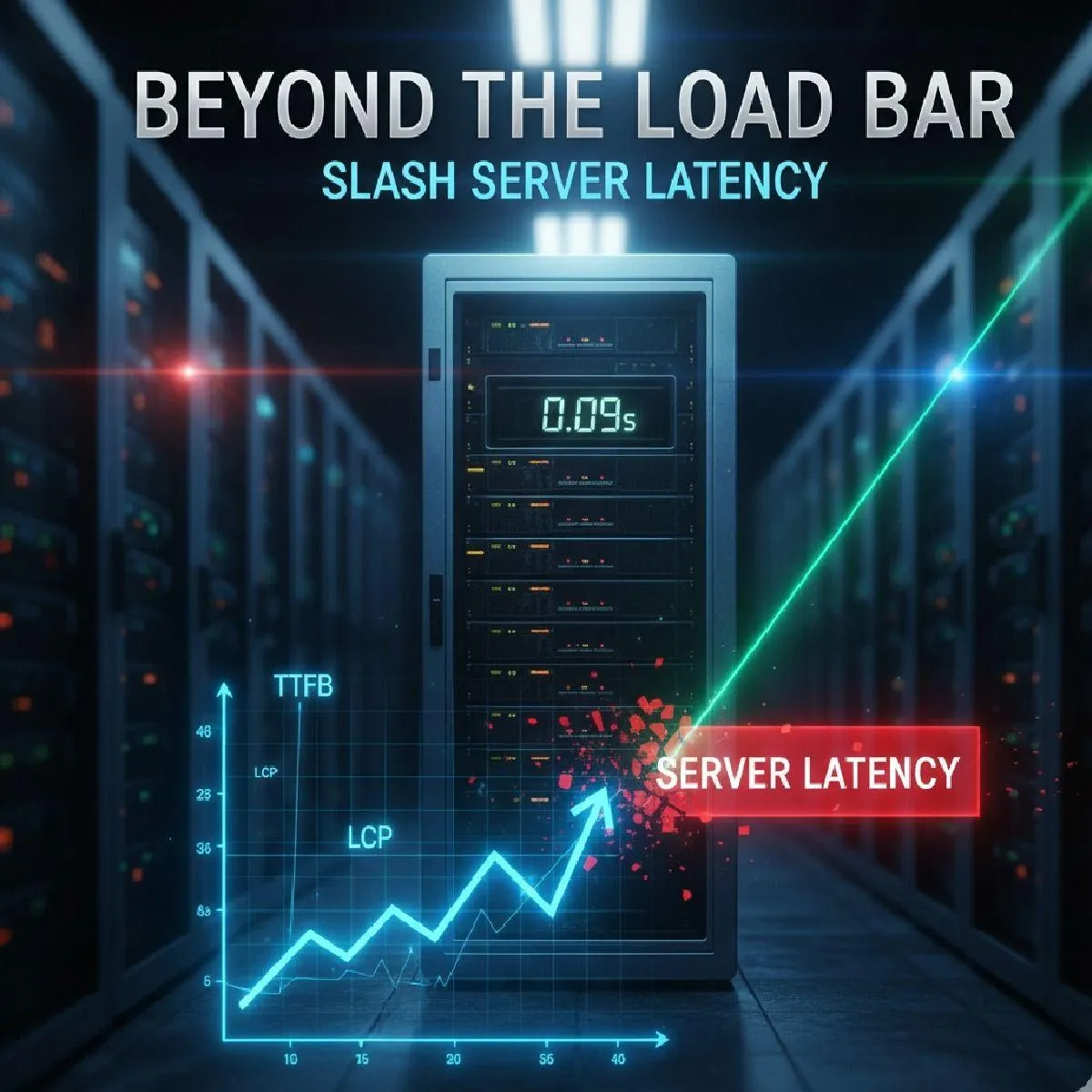
Beyond the Load Bar: How to Slash Server Latency & Boost Your Core Web Vitals for 2026 SEO
You know the feeling: you click a link, and the page just… hangs. In 2026, that fraction of a second isn't just annoying; it's a critical SEO killer. AI search agents don't have patience for slow sites, and neither do your human visitors.
Today, we're diving deep into the single most overlooked metric in SEO: Server Latency, specifically Time to First Byte ($TTFB$). This isn't just a technical detail; it's the bedrock of your site's performance and a make-or-break factor for ranking in the age of AI.
1. What is Server Latency ($TTFB$) and Why Does it Matter More in 2026?
Time to First Byte ($TTFB$) measures the duration from when a user or AI bot initiates a request for your webpage until the very first byte of that page starts arriving from your server. Think of it as the "wake-up time" for your website.
Why it's Crucial for 2026:
AI Agent Efficiency: AI crawlers process billions of pages daily. They prioritize sites that respond instantly. A high $TTFB$ signals an inefficient server, and AI agents simply won't wait.
Core Web Vitals Impact: $TTFB$ is a direct precursor to your Core Web Vitals scores, especially Largest Contentful Paint (LCP). A slow $TTFB$ guarantees a poor LCP, tanking your mobile SEO.
User Experience (UX): Every millisecond counts. Studies show that a 1-second delay can lead to a 7% reduction in conversions. Happy users equal higher dwell time, which signals quality to Google.
Image 1: A diagram illustrating the journey of a request from a user/browser to a server and back, highlighting the TTFB phase. The diagram should be clean and technical.
**

2. Common Culprits Behind High $TTFB$
Before we fix it, let's diagnose the problem:
Underpowered Hosting: Shared hosting plans are often oversold, leading to slow server response times when traffic peaks.
Inefficient Database Queries: A poorly optimized WordPress database can cause significant delays as the server struggles to retrieve content.
Lack of Caching: If your server has to regenerate dynamic content for every single request, $TTFB$ will suffer.
Geographical Distance: If your server is in New York and your audience is in London, the data has further to travel.
Image 2: A visual metaphor showing a slow, outdated server struggling under a pile of requests, perhaps with a "lagging" or "buffering" icon.

3. The Solutions: Optimize Your Server for AI-Grade Speed
Solution 1: Upgrade Your Hosting Infrastructure
This is non-negotiable for 2026. If your host isn't using NVMe SSDs, LiteSpeed servers, and advanced caching, you're already behind.
✨ My Top Recommendation for 2026 Speed ✨
I've personally seen significant $TTFB$ improvements by moving to Hostinger. They are purpose-built for speed with:
NVMe SSD Storage: Ultra-fast data retrieval that minimizes server processing time.
LiteSpeed Web Server: Dramatically faster than Apache, especially for WordPress.
Object Caching: Automatically stores frequently requested data, so your server doesn't have to rebuild content on every visit.
Global Data Centers: Choose a server location closest to your audience for reduced latency.
Solution 2: Implement Aggressive Caching (Server-Side & CDN)
Beyond basic WordPress caching plugins, you need server-level caching.
LiteSpeed Cache: If your host (like Hostinger) uses LiteSpeed, leverage its advanced cache.
CDN (Content Delivery Network): Distributes your static files (images, CSS, JS) to servers worldwide. This drastically reduces the physical distance data has to travel, lowering $TTFB$ for global audiences.
Solution 3: Optimize Your Database
For WordPress users, a bloated database can be a major bottleneck.
Clean Revisions: Limit post revisions in
wp-config.php.Delete Transients: Use a plugin like WP-Optimize to clean out old, expired data.
Remove Unused Plugins/Themes: Every active plugin adds overhead.
Solution 4: Utilize the Latest PHP Versions
Always run the latest stable PHP version (currently PHP 8.x). Each new version brings significant performance improvements. A good host will make this easy to update.
Image 3: A dashboard showing various performance metrics (TTFB, LCP, FCP) with green, positive indicators, suggesting an optimized and fast website. It should look modern and clean.

Conclusion: Don't Let Your Infrastructure Hold You Back
In the hyper-competitive 2026 digital landscape, server latency is more than a technical detail—it's a strategic advantage. By prioritizing a high-performance hosting environment and diligently optimizing your backend, you're not just improving user experience; you're making your content discoverable, citable, and ultimately, more influential to the AI agents that dictate today's search results.
Take control of your $TTFB$ today, and watch your Core Web Vitals (and rankings) soar.
